
Financial Literacy

Financial Literacy

Key Principles of Risk Management

In our previous blogs, we covered the financial principles of budgeting, saving and investing, debt management, and financial planning. In this post, we’ll explain what can disrupt all of them: unexpected financial pressure. Even with a good plan, things will shift. Salary delays. Sudden school fees. Medical bills. A drop in business income. These are common realities, not rare events. Risk management is how you prepare for these situations so they don’t completely throw you off balance. Let’s look at what that means in practice. 1. Be Specific About Your Risks Don’t stop at saying “anything can happen.” Be clear about what can affect you directly. If you’re a salary earner, think about delays in payment or sudden deductions.If you run a business, consider periods when sales drop or customers delay payments.If you support family members, factor in unplanned requests that come up regularly. For example, if you already know that relatives often reach out during school fee periods or emergencies, that is not “unexpected”; it is a pattern. It should be part of your planning. Being specific about them helps you prepare properly instead of reacting every time. 2. Separate What Happens Often From What Hurts Most Not all risks are the same. Some happen frequently, like transport costs increasing, food prices rising, or small monthly shortfalls. These require small, consistent adjustments. Others don’t happen often but can disrupt everything, like hospital bills, major repairs, or losing a source of income. For instance, a ₦5,000–₦10,000 monthly shortfall can be adjusted within your budget. But a sudden ₦200,000 medical expense is a different situation entirely. When you understand this difference, you stop treating all problems the same way and start preparing based on impact. 3. Build Buffers You Can Use Many people have a plan, but no margin for error. If your entire income is already allocated to rent, food, transport, and savings, then any small disruption forces you to borrow or withdraw from money meant for something else. Start small but make it real. For example, setting aside ₦20,000 monthly into a separate account or even keeping a small cash reserve can help you handle a sudden increase in transport fares,  minor medical needs, or urgent household expenses Without that buffer, those same situations often lead to borrowing, which creates a new problem. 4. Reduce Financial Pressure Points Some parts of your financial life create more risk than others. Identify them. High loan repayments are a common problem. If a large portion of your income already goes into debt, even a small disruption can make repayment difficult. Another example is depending on a single source of income. If that source is affected, everything else is affected immediately. You don’t have to fix everything at once, but you should start reducing pressure where you can. For instance: Each small adjustment reduces how vulnerable you are. 5. Check Your Position Regularly Your financial situation is not static. Prices change. Responsibilities increase. Income can improve or drop. What is comfortable six months ago may now feel tight. Take time to review your situation: For example, if your rent, feeding, and transport have all increased but your income has not, your risk level has already changed, even if nothing “bad” has happened yet. Catching this early allows you to adjust before it becomes a real problem. Bringing It Together Risk management is what keeps your finances steady when life becomes unpredictable. It is the reason one person can handle a sudden expense and move on, while another has to start over each time something goes wrong. Start with something simple and practical: Identify one risk in your current situation and take one step this month to reduce it. As we close this series, remember this: financial stability is not about avoiding problems. It is about being prepared for them. Stay intentional, stay consistent, and be patient with yourself.

Financial Literacy

The 5 Key Principles of Financial Planning

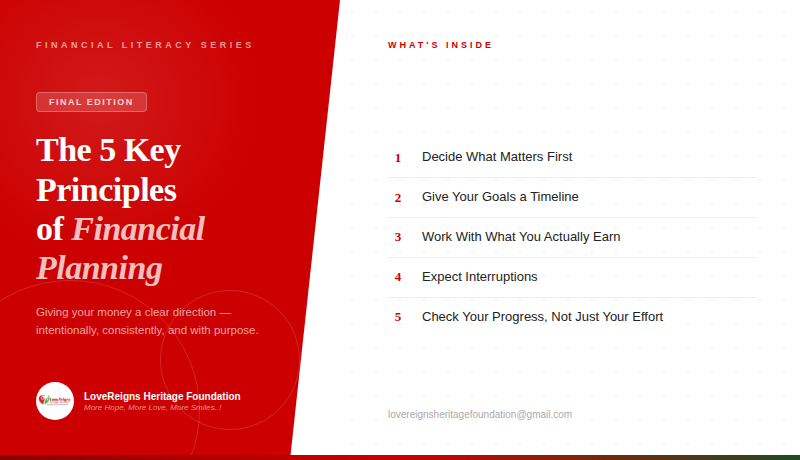
Over the past editions, we’ve walked through the essentials: Budgeting, saving and investing, and managing debt. Each one plays a vital role in shaping how you handle your money every single day. But do you know, even when you’re doing all the “right” things: earning, saving, cutting down on debt, it can still feel like you’re not quite moving forward? Like you’re busy with money, but not necessarily achieving anything with it? If you’ve ever felt that way, don’t worry, you’re not alone. This is where the beauty of financial planning comes in. Financial planning is simply about giving your money a clear sense of direction. It’s deciding ahead of time what you want your money to achieve and ensuring your daily habits align with that vision. Without clarity, it’s easy to stay financially active yet remain stuck in the same place. Think about this… You may be saving consistently, but because there’s no defined purpose, you keep dipping into those savings. Or perhaps your income has increased, but somehow, nothing feels different, because your spending has quietly risen alongside it. It’s a gentle reminder of a powerful truth: “Don’t let your expenses rise just because your salary/earnings/income did.” Planning protects you from this silent drift. It keeps you intentional, focused, and steadily moving forward. Now, let’s walk together into another piece, where we look into how to approach financial planning in a way that truly works for you. 1. Decide What Matters First Before you think about numbers or timelines, pause and ask yourself a simple question: What truly matters to me right now? Is it peace of mind?Is it freedom from constant financial pressure?Is it building something meaningful for your future? Maybe going into business or earning more degrees? When your priorities are clear, everything else begins to fall into place. Decisions become easier, distractions lose their pull, and you move with purpose. 2. Give Your Goals a Timeline A dream without a timeline often remains just that…..A dream. Instead of saying, “I’ll save for this someday,” give it a when. Even if it’s not perfect, it creates a sense of direction and urgency. Timelines do something powerful: they help you measure your progress. You begin to see clearly whether you’re on track or need to adjust your pace. 3. Work With What You Actually Earn Honesty is the foundation of every effective financial plan. One of the quickest ways a financial plan fails is when it is built on assumptions instead of reality. Build your plan around your real income, not what you hope to earn or assume will come. If your income is stable, you can create a structured plan. If it fluctuates, allow your plan to be flexible. For example, working with percentages instead of fixed amounts can help you stay consistent, no matter how your income changes. It keeps you grounded and realistic 4. Expect Interruptions Life happens unexpectedly and often without warning. A plan is not about avoiding surprises; it’s about being prepared for them. Whether it’s an urgent expense or an unforeseen need, what matters is your ability to absorb the shock and keep going. Even a small, consistent buffer can become your safety net. And that makes all the difference. 5. Check Your Progress, Not Just Your Effort It’s easy to feel accomplished because you’re doing something: Saving, cutting back, or trying to earn more. But pause and reflect: Is it working? Are you closer to your goals than you were a few months ago? If not, don’t be discouraged. Just adjust. Sometimes it’s not about trying harder, but about trying differently. Bringing It Together Remember, financial planning is the bridge between your daily habits and the future you truly desire. It brings clarity, structure, and intention to everything you’re already doing. Here’s a simple way to begin: Write down one goal you want to achieve in the next 6–12 months, and one that matters deeply to you in the next few years. Then decide, honestly, what you can set aside for each, starting this month. That’s it. That’s your starting point. You don’t need a perfect plan.You only need a clear direction and the willingness to keep adjusting as you grow.

Financial Literacy

The 5 Non-Negotiables of True Financial Literacy

The difference between earning money and building wealth is financial literacy. Two people can earn the same salary; One saves, plans, and grows steadily, while the other struggles every month. Same income but different outcomes. Two people can take out the same business loan: one expands operations and repays with profits, the other mismanages the funds and ends up deeper in debt. Same opportunity, different results. The question is, which one are you becoming? Financial literacy is not theory; it is not motivational quotes. It is the daily discipline of managing money with intention. It is what you do with every naira that passes through your hands. Below are five core areas of financial literacy, and how to apply them. 1. Budgeting: Tell Your Money Where To Go If you don’t assign your money a purpose, it will disappear without permission. Budgeting simply means deciding in advance where your income should go. If you earn ₦200,000: ₦120,000 may go to fixed expenses (rent, food, transport, utilities), ₦30,000 to savings, ₦20,000 to debt repayment or business growth, ₦30,000 for flexible spending. It doesn’t have to be perfect, it has to be intentional. What you don’t plan for gets spent impulsively. 2. Saving and Investing: Separate the Two Saving protects you, Investing grows you. Savings are your financial shock absorber. Aim for three to six months of essential expenses in an emergency fund and automate it, that is, save immediately income lands, not at the end of the month. Investing comes next. Even small, consistent investments grow through compounding. The earlier you start, the harder your money works for you. If you’re waiting for “extra money” to begin, you’re postponing your future. Start small, start consistently and start now. 3. Debt Management: Borrow With Strategy, Not Emotion Debt is not evil. But careless debt is expensive. Before taking a loan, ask: What exactly is it for? How will it increase my income? How will I repay it? If repayment depends on hope rather than cash flow, the debt is risky. If you already have debt, high-interest debt should be prioritized first to prevent interest from compounding against you. 4. Financial Planning: Turn Goals Into Numbers Vague goals don’t work; specific targets do. Instead of “I want to save,” say: “I want ₦1.2 million in 12 months.” That becomes ₦100,000 per month. Clarity creates action. Break big goals into monthly targets and track progress with simple tools, spreadsheets, apps, or goal-based accounts. When goals are measurable, they become achievable. 5. Risk Management: Protect What You Build It takes years to build wealth, but just one emergency can wipe it out. Unexpected events destroy progress faster than low income. Health issues, accidents, or fraud can wipe out savings.  Financial literacy includes protection, which includes, but is not limited to: securing insurance where appropriate, maintaining diversified income streams, conducting due diligence before any investment, and avoiding “too good to be true” offers. Remember, growth is important, but protection is essential. Wrap Up Financial literacy does not change your income overnight; rather, it will change your direction immediately. When you manage your money intentionally, progress is no longer accidental, stability becomes predictable, and growth becomes sustainable.  You don’t need to earn more to start; you only need to manage better, and that decision can begin today. In the coming weeks, we’ll take a deep dive into each of these five areas, showing practical steps, tools, and examples so you can apply them in your daily life. Stay tuned.

Scroll to Top