
Over the past editions, we’ve walked through the essentials: Budgeting, saving and investing, and managing debt. Each one plays a vital role in shaping how you handle your money every single day.
But do you know, even when you’re doing all the “right” things: earning, saving, cutting down on debt, it can still feel like you’re not quite moving forward? Like you’re busy with money, but not necessarily achieving anything with it?
If you’ve ever felt that way, don’t worry, you’re not alone.
This is where the beauty of financial planning comes in.
Financial planning is simply about giving your money a clear sense of direction. It’s deciding ahead of time what you want your money to achieve and ensuring your daily habits align with that vision. Without clarity, it’s easy to stay financially active yet remain stuck in the same place.
Think about this…
You may be saving consistently, but because there’s no defined purpose, you keep dipping into those savings. Or perhaps your income has increased, but somehow, nothing feels different, because your spending has quietly risen alongside it.
It’s a gentle reminder of a powerful truth: “Don’t let your expenses rise just because your salary/earnings/income did.”
Planning protects you from this silent drift. It keeps you intentional, focused, and steadily moving forward.
Now, let’s walk together into another piece, where we look into how to approach financial planning in a way that truly works for you.
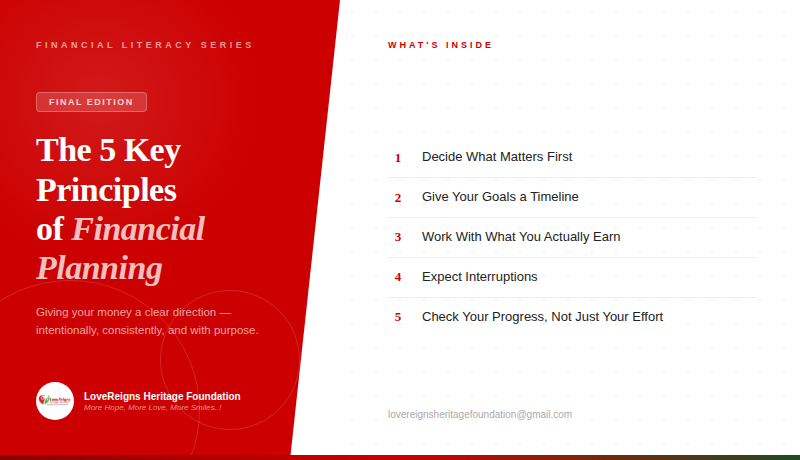
1. Decide What Matters First
Before you think about numbers or timelines, pause and ask yourself a simple question: What truly matters to me right now?
Is it peace of mind?
Is it freedom from constant financial pressure?
Is it building something meaningful for your future? Maybe going into business or earning more degrees?
When your priorities are clear, everything else begins to fall into place. Decisions become easier, distractions lose their pull, and you move with purpose.
2. Give Your Goals a Timeline
A dream without a timeline often remains just that…..A dream.
Instead of saying, “I’ll save for this someday,” give it a when. Even if it’s not perfect, it creates a sense of direction and urgency.
Timelines do something powerful: they help you measure your progress. You begin to see clearly whether you’re on track or need to adjust your pace.
3. Work With What You Actually Earn
Honesty is the foundation of every effective financial plan.
One of the quickest ways a financial plan fails is when it is built on assumptions instead of reality. Build your plan around your real income, not what you hope to earn or assume will come. If your income is stable, you can create a structured plan. If it fluctuates, allow your plan to be flexible.
For example, working with percentages instead of fixed amounts can help you stay consistent, no matter how your income changes. It keeps you grounded and realistic
4. Expect Interruptions
Life happens unexpectedly and often without warning.
A plan is not about avoiding surprises; it’s about being prepared for them. Whether it’s an urgent expense or an unforeseen need, what matters is your ability to absorb the shock and keep going.
Even a small, consistent buffer can become your safety net. And that makes all the difference.
5. Check Your Progress, Not Just Your Effort
It’s easy to feel accomplished because you’re doing something: Saving, cutting back, or trying to earn more.
But pause and reflect: Is it working?
Are you closer to your goals than you were a few months ago?
If not, don’t be discouraged. Just adjust. Sometimes it’s not about trying harder, but about trying differently.
Bringing It Together
Remember, financial planning is the bridge between your daily habits and the future you truly desire. It brings clarity, structure, and intention to everything you’re already doing.
Here’s a simple way to begin:
Write down one goal you want to achieve in the next 6–12 months, and one that matters deeply to you in the next few years. Then decide, honestly, what you can set aside for each, starting this month.
That’s it. That’s your starting point.
You don’t need a perfect plan.
You only need a clear direction and the willingness to keep adjusting as you grow.