Author name: Temitope Kolawole

Uncategorized

LHF Edu-Tour: How We Take Leadership Training to Students

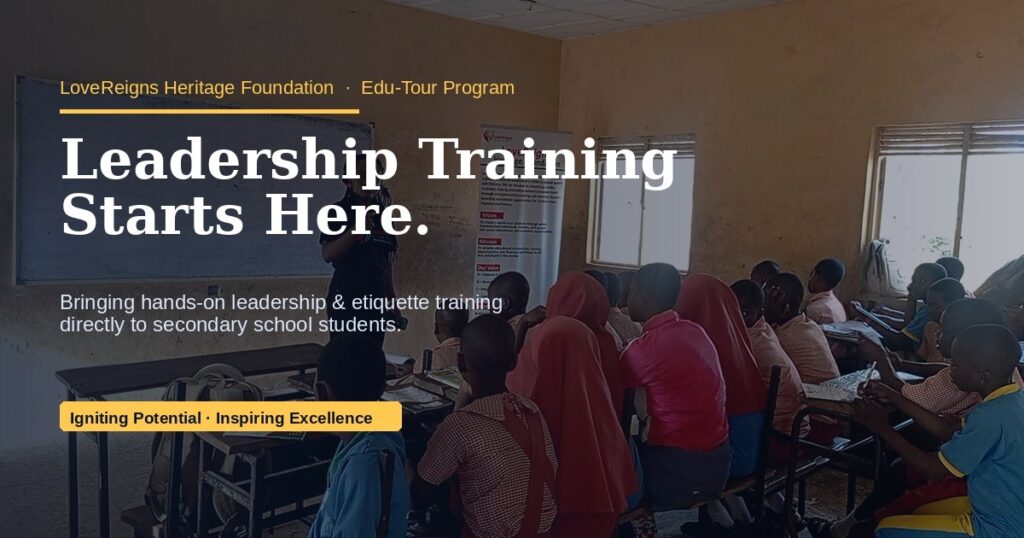
Something caught our attention. Students who receive proper leadership training show a 30% improvement in academic performance. They’re also 40% more likely to step into management roles later in life. But here’s what really surprised us. Students with leadership experience are over 3 times more likely to show positive behavioral changes, and 68% develop higher emotional intelligence!  These are not just numbers we can “wow” about and move on. They are young people who might become more self-aware, more empathetic, and better able to navigate the world around them. Sadly, 58% of managers admit they never received formal training when they first stepped into a leadership role. Not even the ones who were student leaders. They were handed responsibility and expected to figure it out.  This gap has been in workplaces, communities, and families for generations. So we thought, what if we fill the gap, starting early, when the clay is not yet hard, and while it can still be properly shaped like it’s in the hand of the potter? And that’s exactly what we are doing… Meet the LHF Edu-Tour: Leadership Training Comes to Your School We created a mobile outreach program, the LHF Edu-Tour, to bring hands-on leadership and etiquette training directly to secondary schools. We go to them because waiting for students to seek out leadership development on their own is equal to a missed opportunity. It’s a comprehensive, structured program designed to instill foundational values and essential life skills that help young people lead with vision, integrity, and compassion. We meet students where they are and help them see who they could become. We want to help them develop character, discipline, and self-awareness that determine how they show up in every room they walk into, now and for the rest of their lives. What Happens in the Program? Expert-Led Leadership Sessions:  Our experienced mentors work with students on key leadership concepts: responsibility, influence, emotional intelligence, and decision-making. These are not abstract ideas presented from a podium; our facilitators connect them directly to real situations students face every day.  What does it look like to lead when a group project falls apart? How do you make a decision when there’s no clear right answer? Students wrestle with real scenarios, build real frameworks, and leave with tools they can actually use. Etiquette & Character Development  We teach the fundamentals: manners, respect, discipline, and personal presentation. These might sound old-fashioned in an age of casual everything, but they are quiet confidence-builders. How you carry yourself in a room communicates something before you say a word.  Students who master these skills know the rules and understand the reason behind them, and that understanding changes how they present themselves in interviews, in relationships, and in leadership. Interactive Workshops & Activities  We forget the lecture format for the moment. Students don’t retain what they passively receive; they retain what they actively experience. We use storytelling, role-plays, group challenges, and peer engagement to help students internalize values like empathy, teamwork, service, and accountability.  When you act something out, when you feel the discomfort of difficult leadership moments in a safe environment, you own the lesson in a way no slideshow can replicate. Mentorship & Real-Life Guidance  Student leaders connect with mentors who’ve actually led in schools, businesses, and communities. They share real stories: the moments they got it wrong, how they recovered, what they wish they’d known sooner.  This kind of access helps students see that leadership is not reserved for a certain type of person. It’s a skill, and it’s learnable. The First Edition: Christ Africa Church Grammar School We piloted the LHF Edu-Tour at Christ Africa Church Grammar School, running the full program over four weeks from February 26 to March 26, 2026. It was our first real-world test, and the results exceeded what we had hoped for. Over the course of the program, we watched students shift. The way they spoke in group settings. The way they held themselves during presentations. The way they began to notice and name qualities in the people around them. The way students wrapped up the program said everything. Rather than a standard closing ceremony, students nominated the teachers who had best embodied the leadership qualities they’d learned about throughout the four weeks. They also articulated the specific characteristics they had witnessed in those teachers. The discipline, empathy, and  integrity The standout teachers were recognized in front of the students, celebrated not for seniority or subject matter, but for modeling what great leadership actually looks like up close. It was a full-circle moment. Students who came in as learners left as leaders. That’s the shift we’re after. As Bill Bradley said, “Leadership is unlocking people’s potential to become better.” That’s exactly what we saw happen in those four weeks. Why We’re Doing This Leadership shouldn’t be something you stumble into at 28 during a mandatory corporate seminar. It should not be improvised on the job or learned through a decade of costly mistakes. It should be taught early, taught well, and taught in ways that stick in the years when identity is still forming and habits are still being built. Secondary school is not too early. It might actually be exactly the right time. Young people who receive leadership training don’t just perform better in school. They become more intentional in their choices, more considered in how they treat others, and more equipped to take on responsibility without being overwhelmed by it.  They become the kind of citizens who lift others up, solve problems thoughtfully, and step into roles, formal or informal, with a sense of purpose rather than panic. The LHF Edu-Tour is our answer to a question we kept coming back to: What if we stopped waiting for the leadership gap to show up in the workplace or government and started closing it in the classroom? We started with one school. We’re just getting started. So, watch out for edutour 2.0! Coming soon Edu-Tour 2.0 The leadership journey continues. Bigger. Bolder. Reaching more
Financial Literacy

Key Principles of Risk Management

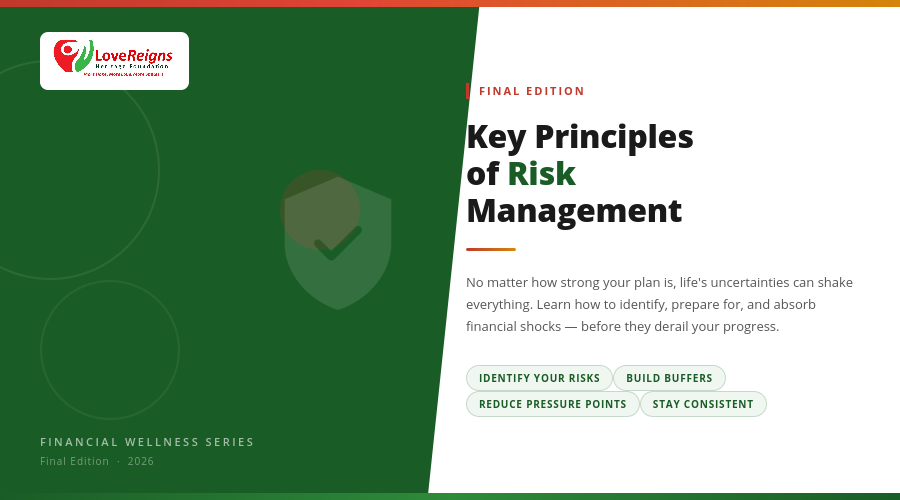
In our previous blogs, we covered the financial principles of budgeting, saving and investing, debt management, and financial planning. In this post, we’ll explain what can disrupt all of them: unexpected financial pressure. Even with a good plan, things will shift. Salary delays. Sudden school fees. Medical bills. A drop in business income. These are common realities, not rare events. Risk management is how you prepare for these situations so they don’t completely throw you off balance. Let’s look at what that means in practice. 1. Be Specific About Your Risks Don’t stop at saying “anything can happen.” Be clear about what can affect you directly. If you’re a salary earner, think about delays in payment or sudden deductions.If you run a business, consider periods when sales drop or customers delay payments.If you support family members, factor in unplanned requests that come up regularly. For example, if you already know that relatives often reach out during school fee periods or emergencies, that is not “unexpected”; it is a pattern. It should be part of your planning. Being specific about them helps you prepare properly instead of reacting every time. 2. Separate What Happens Often From What Hurts Most Not all risks are the same. Some happen frequently, like transport costs increasing, food prices rising, or small monthly shortfalls. These require small, consistent adjustments. Others don’t happen often but can disrupt everything, like hospital bills, major repairs, or losing a source of income. For instance, a ₦5,000–₦10,000 monthly shortfall can be adjusted within your budget. But a sudden ₦200,000 medical expense is a different situation entirely. When you understand this difference, you stop treating all problems the same way and start preparing based on impact. 3. Build Buffers You Can Use Many people have a plan, but no margin for error. If your entire income is already allocated to rent, food, transport, and savings, then any small disruption forces you to borrow or withdraw from money meant for something else. Start small but make it real. For example, setting aside ₦20,000 monthly into a separate account or even keeping a small cash reserve can help you handle a sudden increase in transport fares,  minor medical needs, or urgent household expenses Without that buffer, those same situations often lead to borrowing, which creates a new problem. 4. Reduce Financial Pressure Points Some parts of your financial life create more risk than others. Identify them. High loan repayments are a common problem. If a large portion of your income already goes into debt, even a small disruption can make repayment difficult. Another example is depending on a single source of income. If that source is affected, everything else is affected immediately. You don’t have to fix everything at once, but you should start reducing pressure where you can. For instance: Each small adjustment reduces how vulnerable you are. 5. Check Your Position Regularly Your financial situation is not static. Prices change. Responsibilities increase. Income can improve or drop. What is comfortable six months ago may now feel tight. Take time to review your situation: For example, if your rent, feeding, and transport have all increased but your income has not, your risk level has already changed, even if nothing “bad” has happened yet. Catching this early allows you to adjust before it becomes a real problem. Bringing It Together Risk management is what keeps your finances steady when life becomes unpredictable. It is the reason one person can handle a sudden expense and move on, while another has to start over each time something goes wrong. Start with something simple and practical: Identify one risk in your current situation and take one step this month to reduce it. As we close this series, remember this: financial stability is not about avoiding problems. It is about being prepared for them. Stay intentional, stay consistent, and be patient with yourself.

Financial Literacy

The 5 Key Principles of Financial Planning

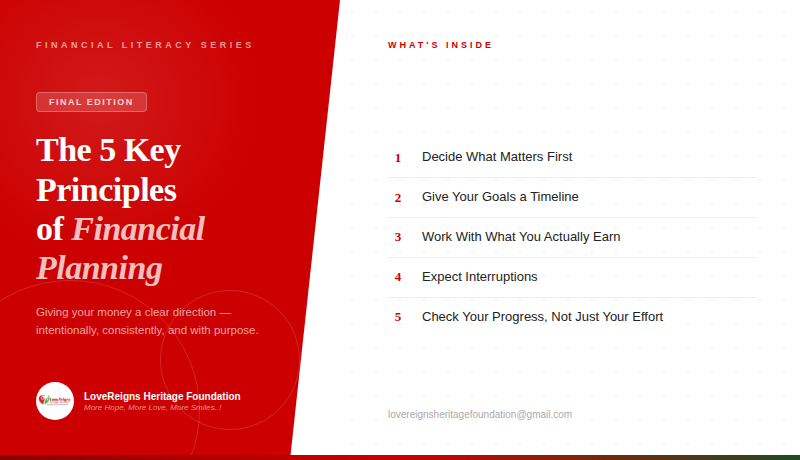
Over the past editions, we’ve walked through the essentials: Budgeting, saving and investing, and managing debt. Each one plays a vital role in shaping how you handle your money every single day. But do you know, even when you’re doing all the “right” things: earning, saving, cutting down on debt, it can still feel like you’re not quite moving forward? Like you’re busy with money, but not necessarily achieving anything with it? If you’ve ever felt that way, don’t worry, you’re not alone. This is where the beauty of financial planning comes in. Financial planning is simply about giving your money a clear sense of direction. It’s deciding ahead of time what you want your money to achieve and ensuring your daily habits align with that vision. Without clarity, it’s easy to stay financially active yet remain stuck in the same place. Think about this… You may be saving consistently, but because there’s no defined purpose, you keep dipping into those savings. Or perhaps your income has increased, but somehow, nothing feels different, because your spending has quietly risen alongside it. It’s a gentle reminder of a powerful truth: “Don’t let your expenses rise just because your salary/earnings/income did.” Planning protects you from this silent drift. It keeps you intentional, focused, and steadily moving forward. Now, let’s walk together into another piece, where we look into how to approach financial planning in a way that truly works for you. 1. Decide What Matters First Before you think about numbers or timelines, pause and ask yourself a simple question: What truly matters to me right now? Is it peace of mind?Is it freedom from constant financial pressure?Is it building something meaningful for your future? Maybe going into business or earning more degrees? When your priorities are clear, everything else begins to fall into place. Decisions become easier, distractions lose their pull, and you move with purpose. 2. Give Your Goals a Timeline A dream without a timeline often remains just that…..A dream. Instead of saying, “I’ll save for this someday,” give it a when. Even if it’s not perfect, it creates a sense of direction and urgency. Timelines do something powerful: they help you measure your progress. You begin to see clearly whether you’re on track or need to adjust your pace. 3. Work With What You Actually Earn Honesty is the foundation of every effective financial plan. One of the quickest ways a financial plan fails is when it is built on assumptions instead of reality. Build your plan around your real income, not what you hope to earn or assume will come. If your income is stable, you can create a structured plan. If it fluctuates, allow your plan to be flexible. For example, working with percentages instead of fixed amounts can help you stay consistent, no matter how your income changes. It keeps you grounded and realistic 4. Expect Interruptions Life happens unexpectedly and often without warning. A plan is not about avoiding surprises; it’s about being prepared for them. Whether it’s an urgent expense or an unforeseen need, what matters is your ability to absorb the shock and keep going. Even a small, consistent buffer can become your safety net. And that makes all the difference. 5. Check Your Progress, Not Just Your Effort It’s easy to feel accomplished because you’re doing something: Saving, cutting back, or trying to earn more. But pause and reflect: Is it working? Are you closer to your goals than you were a few months ago? If not, don’t be discouraged. Just adjust. Sometimes it’s not about trying harder, but about trying differently. Bringing It Together Remember, financial planning is the bridge between your daily habits and the future you truly desire. It brings clarity, structure, and intention to everything you’re already doing. Here’s a simple way to begin: Write down one goal you want to achieve in the next 6–12 months, and one that matters deeply to you in the next few years. Then decide, honestly, what you can set aside for each, starting this month. That’s it. That’s your starting point. You don’t need a perfect plan.You only need a clear direction and the willingness to keep adjusting as you grow.

Uncategorized

The Subtle Benefits and Differences Between Saving and Investing

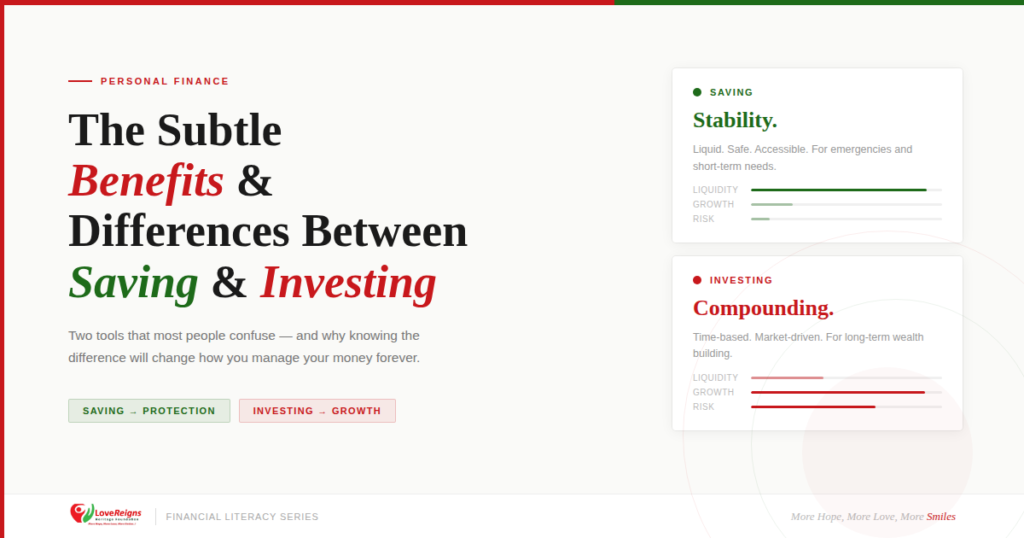
Most people treat “saving” and “investing” as synonyms for the same habit. They’re not. Each has its own place, and they both should be done.  For example, you can save a portion of your income and feel safe, but it doesn’t grow. Or you invest money you might need next month, and end up frustrated when life throws an emergency bill at you. One keeps you safe while the other builds wealth. Using them interchangeably or skipping one entirely are among the financial mistakes people make. Here’s how to think about both clearly. Saving Is for Stability, Not Growth When you save money, you’re essentially setting cash aside in a place you can reach quickly, such as a bank account, a fixed deposit with short tenure, or somewhere low-risk and liquid.  The purpose is stability. You save so that when your car breaks down, or a family member needs help, or you lose a client for two months, you don’t have to borrow or sell something you didn’t plan to sell. Saving is your financial buffer against life’s unpredictability, which it always is. The trouble is that many people treat savings like an investment. They pile money into a savings account, watch it earn 3-4% interest annually, and feel like they’re building something.  They’re not in the long run. Inflation chips away at that balance. If prices are rising at 15% a year and your savings account pays 4%, your money loses purchasing power every month it sits there.  Saving keeps you protected. It does not make you richer. Investing is where growth happens. When you invest in stocks, mutual funds, real estate, index funds, or a business, you’re putting money to work in a way that’s meant to outpace inflation over time.  The mechanism behind this is compounding: your returns generate their own returns, and given enough years, the numbers stop being linear and start looking geometric. Someone who puts ₦50,000 into a diversified mutual fund at 25 and leaves it alone will almost certainly have more at 45 than someone who starts at 35 with twice the amount. Time is the difference.  The money had more years to compound. This is why people who invest earlier tend to end up further ahead, even when they earn less than their peers who delayed. Investing only makes sense with money you won’t need anytime soon. If you invest your emergency fund and the market dips 20% the same month your landlord raises rent, you either sell at a loss or scramble to cover the rent.  That’s the trap of mixing the two up. What this looks like in practice Let’s say you earn ₦350,000 a month from salary, freelance, small business, whatever the source. A reasonable split might look something like this:  After covering your necessary expenses (rent, food, transport, obligations), you have about ₦100,000 left to work with. Of that, you could direct ₦40,000 into savings, building toward three to six months of expenses in a stable, accessible account, and ₦60,000 into an investment vehicle, such as a mutual fund or a dollar-denominated asset, if you want some currency protection. The savings portion just sits there. But it’s doing a job: making sure you never have to liquidate your investments at the wrong time because an emergency shows up. In a nutshell, the investment portion is the part that, five or ten years from now, will look meaningfully different from what you put in, assuming the market does what markets have historically done over long periods: grow. Why do people delay, and why does that delay compound too There’s always a reason to wait. The month isn’t good. There’s a wedding to fund, school fees, and a business expense that came up. These are real pressures, not excuses, and anyone who dismisses them hasn’t met a real budget.  But the delay has a cost that’s easy to underestimate because it’s invisible, it’s the growth that didn’t happen, the years of compounding that didn’t start. What tends to work is automating both. When money moves into a savings account or investment fund before you see it in your main balance, you stop seeing it as available.  People who automate these transfers consistently end up with more saved and more invested than those who plan to do it manually at the end of the month, because the end of the month has a way of arriving with nothing left. eMBED code for mailer: Newsletter Signup for news and special offers! Subscribe Loading… Thank you! You have successfully joined our subscriber list.

Uncategorized

Budgeting: Tell Your Money Where to Go

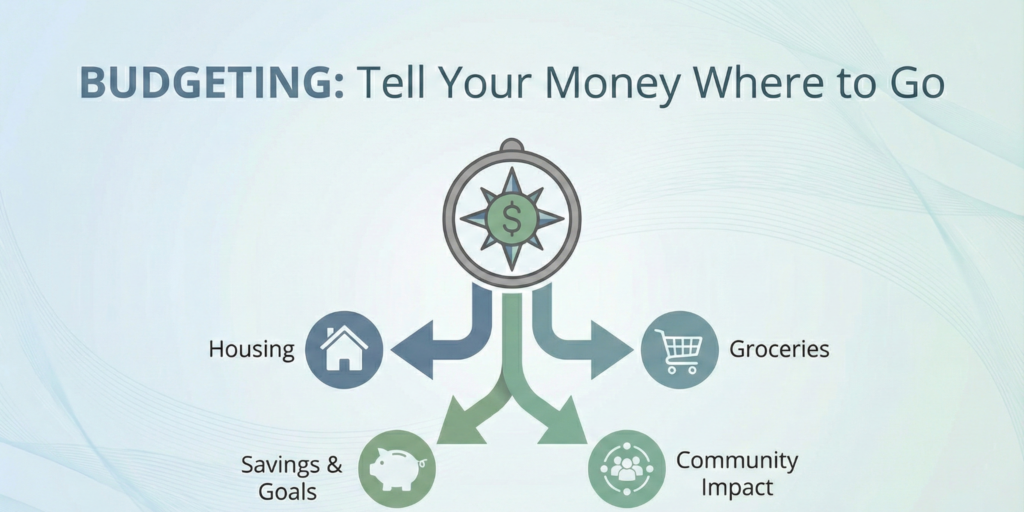
Most of us treat our bank accounts like a mystery box. We check our balance just before making a transfer and hope the money lasts until the next salary enters. This way of living creates a constant, low-level stress that follows us everywhere. The problem is not usually that we do not know how to subtract expenses from income. The problem is that we view budgeting as a financial “dieting” where we cut out everything good.  But a true budget is not about being stingy to yourself or others; it is simply a way to spend your money without guilt. Give Every Naira a Job The best way to take control is the “zero-based” method. The idea is that, before the month starts, you take your total income and give every single Naira a specific job until you have zero Naira left unassigned. This does not mean your account balance hits zero; it means you have decided exactly where every kobo is going. Let’s look at a practical example. Imagine your take-home pay is ₦300,000 a month. First, you cover the Essentials. These are the bills you must pay to survive: rent (saving a bit monthly towards the yearly payment), food, electricity/fuel, and transport. Let’s say this takes up ₦160,000. You now have ₦140,000 remaining. Next, look at Debt and Savings. If you have loans or are saving for an emergency fund (for when life happens), that money should move now. Let’s assume this takes another ₦60,000. You are left with ₦80,000. This is where most people lose control. They leave this money in the account and tap their card or make transfers until it is gone.  Instead, you must assign this to Flexible Spending. This includes data, eating out, airtime, and family obligations (“black tax”). The magic happens when you realize you have set aside ₦15,000 specifically for “Enjoyment.” When you buy lunch or go out with friends, you don’t feel worried. You know you can afford it. You planned for it. Stop Guessing, Start Checking A budget on paper is useless if it does not match real life. You have to track where the money actually goes.  Research shows that people are very bad at “mental accounting”; we consistently overestimate how much we spend on small things like data top-ups, snacks, or transport fares. To fix this, you need a routine. You don’t need to write down every expense as it happens, but you do need to review it regularly. Try the “Weekly Check-In.” Pick a time, maybe Sunday evening, to review your spending from the last seven days. This helps you catch mistakes or see if you are spending too fast. If you notice by the middle of the month that food prices have gone up and you have spent more on groceries than you planned, don’t give up. Simply look at your other categories. Can you move ₦5,000 from the “Clothes” or “Data” money to cover the food? This is what experts call “slack” or wiggle room. Rigid plans break easily; flexible plans survive. Moving money from one category to another is not failing; it is managing. Making It Stick The goal here is not to create a perfect spreadsheet. The goal is to build a habit that reduces your stress. Start by looking at your bank statement for the last few months to see what you actually spend, not what you wish you spent. If you spend a lot on data, put it in the budget. If you hate cooking and buy food often, budget for it. When your plan matches your real life, budgeting stops feeling like a chore. It starts feeling like a clearer way to see your life. You stop wondering where your money went and start telling it where to go. Newsletter Signup for news and special offers! Subscribe Loading… Thank you! You have successfully joined our subscriber list.

Financial Literacy

The 5 Non-Negotiables of True Financial Literacy

The difference between earning money and building wealth is financial literacy. Two people can earn the same salary; One saves, plans, and grows steadily, while the other struggles every month. Same income but different outcomes. Two people can take out the same business loan: one expands operations and repays with profits, the other mismanages the funds and ends up deeper in debt. Same opportunity, different results. The question is, which one are you becoming? Financial literacy is not theory; it is not motivational quotes. It is the daily discipline of managing money with intention. It is what you do with every naira that passes through your hands. Below are five core areas of financial literacy, and how to apply them. 1. Budgeting: Tell Your Money Where To Go If you don’t assign your money a purpose, it will disappear without permission. Budgeting simply means deciding in advance where your income should go. If you earn ₦200,000: ₦120,000 may go to fixed expenses (rent, food, transport, utilities), ₦30,000 to savings, ₦20,000 to debt repayment or business growth, ₦30,000 for flexible spending. It doesn’t have to be perfect, it has to be intentional. What you don’t plan for gets spent impulsively. 2. Saving and Investing: Separate the Two Saving protects you, Investing grows you. Savings are your financial shock absorber. Aim for three to six months of essential expenses in an emergency fund and automate it, that is, save immediately income lands, not at the end of the month. Investing comes next. Even small, consistent investments grow through compounding. The earlier you start, the harder your money works for you. If you’re waiting for “extra money” to begin, you’re postponing your future. Start small, start consistently and start now. 3. Debt Management: Borrow With Strategy, Not Emotion Debt is not evil. But careless debt is expensive. Before taking a loan, ask: What exactly is it for? How will it increase my income? How will I repay it? If repayment depends on hope rather than cash flow, the debt is risky. If you already have debt, high-interest debt should be prioritized first to prevent interest from compounding against you. 4. Financial Planning: Turn Goals Into Numbers Vague goals don’t work; specific targets do. Instead of “I want to save,” say: “I want ₦1.2 million in 12 months.” That becomes ₦100,000 per month. Clarity creates action. Break big goals into monthly targets and track progress with simple tools, spreadsheets, apps, or goal-based accounts. When goals are measurable, they become achievable. 5. Risk Management: Protect What You Build It takes years to build wealth, but just one emergency can wipe it out. Unexpected events destroy progress faster than low income. Health issues, accidents, or fraud can wipe out savings.  Financial literacy includes protection, which includes, but is not limited to: securing insurance where appropriate, maintaining diversified income streams, conducting due diligence before any investment, and avoiding “too good to be true” offers. Remember, growth is important, but protection is essential. Wrap Up Financial literacy does not change your income overnight; rather, it will change your direction immediately. When you manage your money intentionally, progress is no longer accidental, stability becomes predictable, and growth becomes sustainable.  You don’t need to earn more to start; you only need to manage better, and that decision can begin today. In the coming weeks, we’ll take a deep dive into each of these five areas, showing practical steps, tools, and examples so you can apply them in your daily life. Stay tuned.

Uncategorized

Achieving SDG 4: Quality Education for All and Sundry In Nigeria

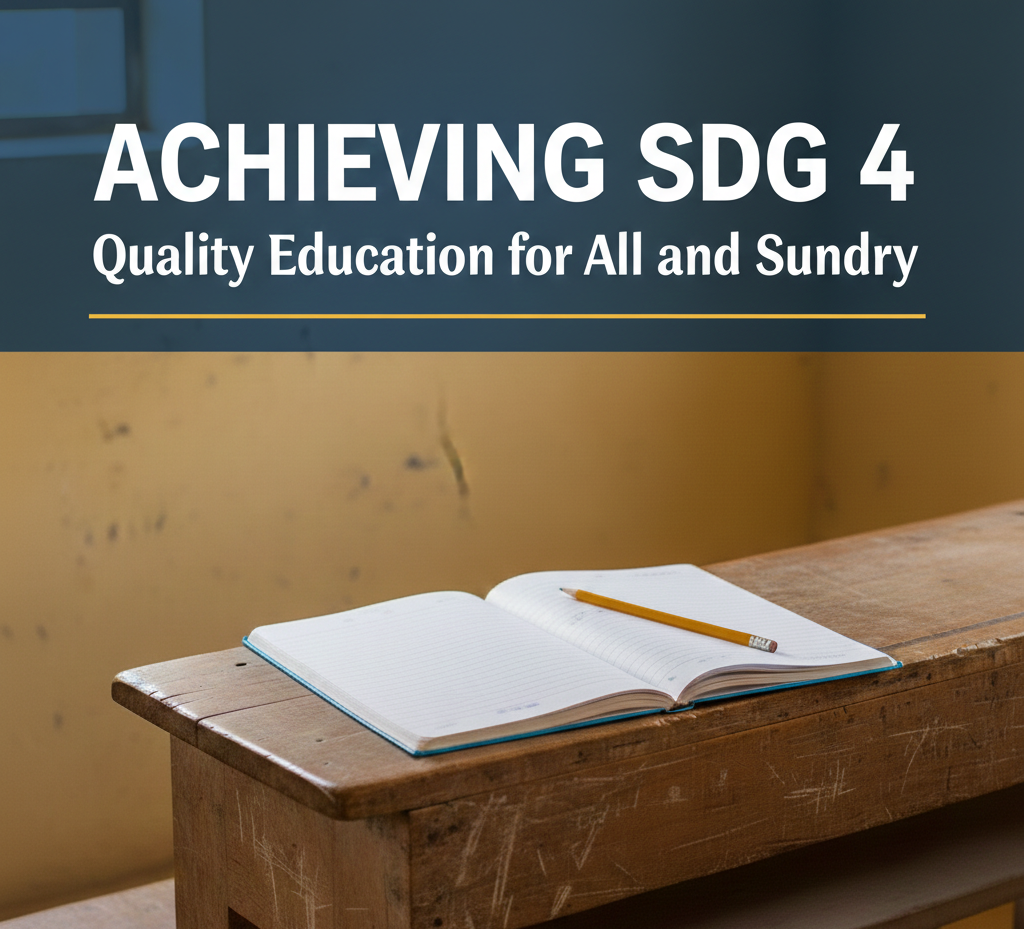
SDG 4 aims to ensure inclusive, equitable, quality education and promote lifelong learning opportunities for all by 2030. With just four years left, how close are we? Globally, more than 250 million children and young people are out of school. But the challenge goes beyond access. In many cases, schooling does not translate into learning. Children attend school yet leave without basic literacy or numeracy skills. Using Nigeria as a case study, there are more than 20 million out-of-school children, the highest figure worldwide. For many who are enrolled, classrooms are overcrowded and dilapidated, textbooks are shared, and teachers are stretched thin.  Insecurity, poverty, and weak education funding have continued to disrupt learning, especially in rural and low-income communities.  So, is achieving SDG 4 in Nigeria still possible? Yes, but only with focused, practical action rather than broad promises. Below are six steps that can make real progress possible: 1. Empower teachers Quality education begins with teachers; however, empowerment goes beyond recruitment. We need to consistently pay teachers’ salaries on time, maintain smaller class sizes, and provide regular training focused on classroom realities, not one-off seminars.  Training should cover modern teaching methods, basic digital tools, and subject mastery. When teachers are supported and held accountable, learning outcomes improve immediately. 2. Fix basic school infrastructure Many Nigerian schools lack essentials such as desks, functional toilets, electricity, and safe classrooms. Nobody can learn well under these conditions. Government Investment in education should prioritize basic facilities before advanced reforms.  Reliable school buildings, clean water, and simple learning tools create environments where students can concentrate and teachers can teach effectively. 3. Make learning relevant to real life Most students leave school without skills they can use outside the classroom. Education should develop problem-solving skills, communication skills, and digital literacy, alongside reading and mathematics.  Technical and vocational education should also be strengthened and respected, offering pathways into trades, technology, and small-scale entrepreneurship rather than being treated as a last option. 4. Keep children in school through social support Poverty remains a major reason children drop out. Programs such as school feeding, transport support, and conditional cash transfers help families keep children in school. For example, the Mimiko Free Mega buses in Ondo State that year helped so many students reduce the burden of transportation. These interventions are practical, affordable, and proven to increase attendance, especially for girls and children in low-income households. 5. Prioritize inclusion, not just access Girls, children with disabilities, displaced learners, and those in remote areas face the highest barriers.  Inclusion requires deliberate planning, ramps and assistive learning tools for children with disabilities, flexible school schedules for nomadic communities, and safe learning environments for girls.  Without targeted strategies, “education for all” remains incomplete. 6. Strengthen community responsibility Schools function better when communities are involved. Parents, traditional leaders, and local organizations can monitor attendance, report teacher absenteeism, and protect school facilities.  When communities see schools as shared assets, dropout rates will fall, and accountability will improve. Wrapping Up Achieving SDG 4 in Nigeria depends on focusing resources where they matter most: teachers, basic infrastructure, relevant skills, and inclusive support systems.  Quality education is not an abstract goal; it is a practical investment in the country’s social and economic future.

Uncategorized

New Year Resolutions: Facts, Myths, and What Really Works

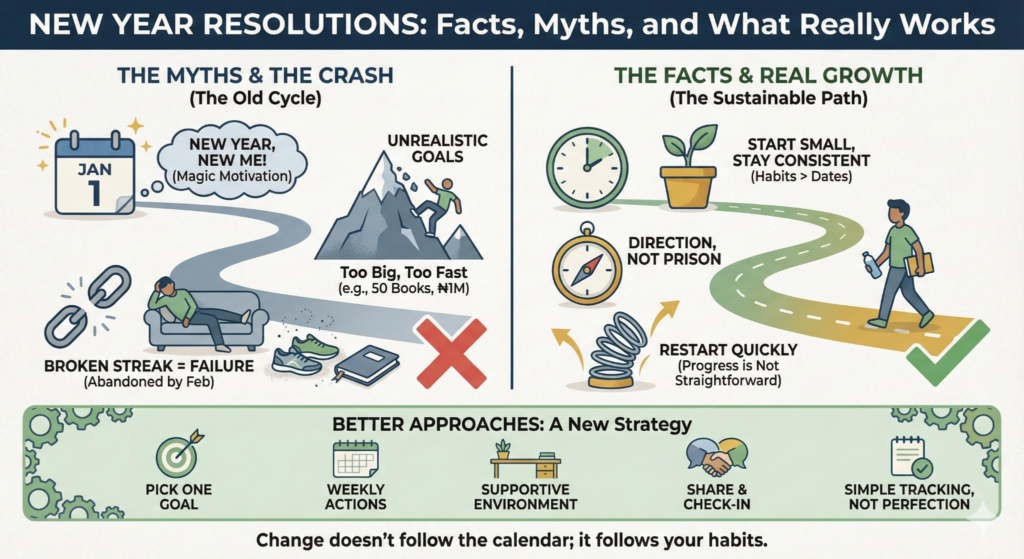
Every January, we start the year with fire in our bones. We write long lists of goals, determined that this year will be different, and promise ourselves a fresh start. But then, halfway into the year, those same goals are quietly abandoned.  The notebook closes. The gym shoes gather dust. And you look at yourself and ask, “Is this me again? Then again, you say next year. Maybe you planned to learn a skill, save more money, read more books, or finally start that project. But now it’s the end of the year, and nothing has moved.  So you may be wondering: must there always be “new year, new me”? Why do people fail their resolutions? And what exactly is a resolution, and what is it not? Let’s unwrap some facts and myths. Myth 1: A new year automatically brings new motivation People assume January has magical energy. It doesn’t. Dates don’t change people; habits do. A man once told me he waited till January to start eating healthy.  By February, he was back to late-night snacks because he didn’t change the environment around him. If you keep the same habits, you get the same results, no matter the month. Fact: People succeed when they start small and stay consistent Someone who starts walking 10 minutes a day is more likely to stay consistent than someone who begins with a strict one-hour plan. The brain prefers gradual change. Small steps compound. Myth 2: A resolution must be big to matter Many people fail because their goals are too dramatic. “I will read 50 books.” “I will save ₦1 million.” “I will lose 20kg.” These goals sound inspiring, but they create pressure. When the first slip happens, discouragement follows. Fact: A resolution is a direction, not a Prison Real progress is about gently adjusting your life, not forcing it with a set of new, rigid rules. If you want to write a book next year, you do not have to complete a chapter a day or a week.  Myth 3: If you miss a day, you have failed This single belief destroys more resolutions than anything else. People quit simply because they broke the streak. Fact: Progress is not straightforward The bible says, “The godly may trip seven times, but they will get up again. But one disaster is enough to overthrow the wicked.”  Missing a day is normal. What matters is restarting quickly, not perfectly. Keep going!  So, what should a resolution actually be?  A resolution is a commitment to improve your life at your own pace, not a strict pledge tied to January. It is not a magic formula, a competition, or a performance for social media. It is simply a promise to yourself that you are willing to keep in small steps. Better approaches you can try: As you step into the next season, do not focus on a new year. But instead, focus on a new strategy and remember, change doesn’t follow the calendar; it follows your habits.

Self-Development, Uncategorized

Three Simple Ways to Truly Reflect on the Year 2025

I recently heard a friend say, “One thing I did this year is that I kept going. In the middle of depression, chaos, spiritual warfare, and everything in between. I kept going!” Reflection is how you turn a year of survival into a year of lessons. Truly, the same challenge that frustrated you in March might still be stressing you out in November. Perhaps, it could be simply because you never paused to ask, “Why does this keep happening?” Einstein once said, “The definition of insanity is doing the same thing over and over again and expecting different results.”  On the other hand, you may have made tremendous progress and entirely forgotten the small wins. The times you paid off a small debt, showed up consistently at work even when you did not feel like it, or rebuilt your confidence after a disappointment.  This is where reflection comes in. Without reflection, these moments disappear, and you enter the new year believing you did “nothing.” Reflection makes you stop carrying old patterns blindly. It is how you stop repeating the same argument with the same person about the same thing. It is how you make your progress visible again. And it does not necessarily need a fancy journal or a week-long retreat. Just a few intentional minutes. How do you reflect on 2025 properly, without judging yourself or feeling complacent? Here are three simple, pressure-free ways to make sense of 2025 before you step into 2026. 1. The High / Low / Lesson Snapshot This is one of the quickest ways to understand your year without writing a whole essay. It takes in 3 points: The high, the low, and the lesson.  The High: Those moments where you were proud, relieved, or genuinely yourself. Maybe you were consistent in a routine you usually abandon. Maybe you finally had the courage to apply for something or talk to the love of your life. Maybe you repaired a relationship you thought was gone. The Low: The moment that drained you or forced you to slow down. It could be a financial setback, burnout from work, a rejection, a heartbreak, a project that failed, or a season where you felt lonely. Naming it helps you stop pretending it didn’t happen. Now think about The Lesson. The small piece of wisdom you gained from that low point.At first, you might not find any, but think deeply, stay with it, and you’ll find some. Something practical like, “I need to stop saying yes when I’m exhausted,” or I underestimate how much rest affects my performance,” or “I should have asked for clarity before agreeing to things.” This three-part snapshot gives you a clean, honest summary of your year and what you need to carry forward into the drop in the following year. 2. The Five-Item Wins List Our brains hold on to mistakes, but they quietly skip over progress. This is why you can have a decent year and still feel like you “did nothing.” I’ll recommend a five-item wins list fixes that. Think of five things you completed or improved this year, even if they were small. Here’s an example: These “small wins” tell the true story of your year: steady growth, not sudden breakthroughs. And they template to what you can do better the next year. 3. Write a Guidance Letter to Your January 2025 Self This one helps you hear your own wisdom clearly. Imagine writing to the earlier version of yourself who had no idea what was coming. You’re not giving predictions, you’re sharing guidance you wish you had carried from the start. For example: This letter shows you what the year taught you at a deeper level, not just events, but the mindset that would have made the journey smoother. Summarily, don’t mistake reflection for judging yourself; instead, it’s about paying attention to your life so you don’t repeat what drained you, and so you can build on what strengthened you.  These three simple techniques help you walk into 2026 with more self-awareness, more kindness towards yourself, and a clearer sense of direction. Take whichever one speaks to you and start there. Your year has a lot to tell you. Newsletter Signup for news and special offers! Subscribe Loading… Thank you! You have successfully joined our subscriber list.

Success Tips

5 Study Habits That Build Success Beyond the Classroom

You have probably been there, studied for hours, highlighted every line, and still blanked out when it is time to write in the exam hall. It is frustrating, and sometimes you might ask, “Why is this happening?” Do you need to study more? Or you’re not just cut for books? The truth is, top students are not always the ones who study the longest. They’re the ones who have figured out how to study smarter.  Over time, researchers and high performers have identified habits that boost grades, build focus, and foster confidence and problem-solving skills useful in any career. When I learned this at Obafemi Awolowo University, I started having GPAs of 4.5/5.0 and above, as opposed to my former frustrating 3 points. Here are five study habits that can make a lasting difference. 1. Practice Retrieval, Don’t Just Reread Most of the time, students go over the same notes again and again. You recognise every sentence and think you’ve mastered it. But when it is time to explain the topic, your mind suddenly goes blank. That is because recognition is not the same as recall. Recognition means your brain knows it has seen the information before. Recall means your brain can bring it out without seeing it again. To learn effectively, you need recall. A Purdue University study found that students who tested themselves remembered about 50% more than those who only reread.  After reading a topic, close your notebook and try explaining it aloud, like you’re teaching someone else. You’ll quickly see which parts you truly understand, and your brain will store them better. 2. Use Spaced Repetition Most people cram before exams, thinking it is efficient. My friend, it is not. Information learned that way fades fast because the brain does not get time to rest and rebuild the memory. Spaced repetition works differently; it spreads your study over several days so your brain can review the information again and again at just the right time. For example, if you are preparing for a history exam, read a topic on Monday, review it briefly on Wednesday, and test yourself again next week. Each review strengthens your memory. Apps like Anki or Quizlet make this easier by reminding you when to revisit each topic. 3. Reflect on What Works  Sometimes it is not the subject that is hard, but the method. Reflection simply means thinking about how you learn. Take a few minutes each week to ask questions like, “What helped me focus this week?” or “When did I get distracted?” You might find that you learn faster in the morning or that drawing diagrams helps you understand better. Writing these small lessons down helps you build a study routine that fits you. It is the same thing athletes and successful professionals do when they review what went well and what to improve next time. 4. Connect Learning to Real Life Concepts make more sense when they connect to things you already know. That is why you remember song lyrics or football scores easily; they relate to real experiences. When you connect your schoolwork to daily life, your brain pays more attention. A student learning statistics can track how many goals their team scored in a season. A business student can apply marketing ideas to promote a small online store. A science student can relate experiments to everyday problems, such as clean water and healthy food. Real-world examples make learning natural and memorable. 5. Choose Consistency Over Intensity You might think doing all-night (Overnight) is productive, but it doesn’t help your brain store information properly. Consistency means studying a little every day instead of everything at once. The Pomodoro technique, 25 minutes of study followed by a 5-minute break, helps you stay focused and fresh. Reading one chapter daily or revising for 20 minutes before bed may not seem like much, but over time, it adds up. This steady rhythm builds understanding, confidence, and discipline, which make a real difference not just in school but in work and life. Effective study habits go beyond grades. They help you stay curious, focused, and ready for challenges, skills that will keep shaping your success long after the classroom. Calling It A Wrap Learning is about understanding how your mind works and using it wisely. The more you practice these techniques, the more confident and capable you become in remembering and applying what you learn. If you found this helpful, subscribe to our newsletter to get more practical learning tips, productivity hacks, and success habits that help you grow in Life. Newsletter Signup for news and special offers! Subscribe Loading… Thank you! You have successfully joined our subscriber list.

Scroll to Top