
I recently heard a friend say, “One thing I did this year is that I kept going. In the middle of depression, chaos, spiritual warfare, and everything in between. I kept going!”
Reflection is how you turn a year of survival into a year of lessons.
Truly, the same challenge that frustrated you in March might still be stressing you out in November. Perhaps, it could be simply because you never paused to ask, “Why does this keep happening?”
Einstein once said, “The definition of insanity is doing the same thing over and over again and expecting different results.”
On the other hand, you may have made tremendous progress and entirely forgotten the small wins. The times you paid off a small debt, showed up consistently at work even when you did not feel like it, or rebuilt your confidence after a disappointment.
This is where reflection comes in. Without reflection, these moments disappear, and you enter the new year believing you did “nothing.”
Reflection makes you stop carrying old patterns blindly. It is how you stop repeating the same argument with the same person about the same thing. It is how you make your progress visible again. And it does not necessarily need a fancy journal or a week-long retreat. Just a few intentional minutes.
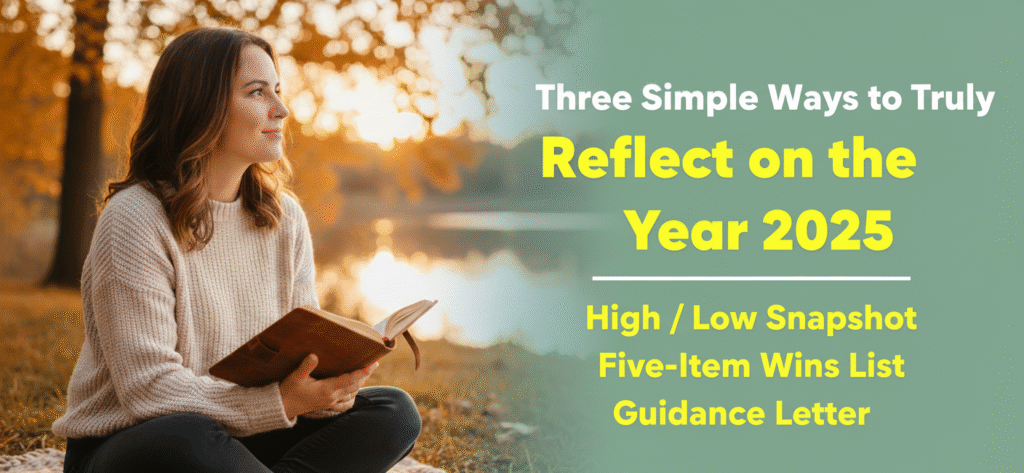
How do you reflect on 2025 properly, without judging yourself or feeling complacent? Here are three simple, pressure-free ways to make sense of 2025 before you step into 2026.
1. The High / Low / Lesson Snapshot
This is one of the quickest ways to understand your year without writing a whole essay. It takes in 3 points: The high, the low, and the lesson.
The High: Those moments where you were proud, relieved, or genuinely yourself. Maybe you were consistent in a routine you usually abandon. Maybe you finally had the courage to apply for something or talk to the love of your life. Maybe you repaired a relationship you thought was gone.
The Low: The moment that drained you or forced you to slow down. It could be a financial setback, burnout from work, a rejection, a heartbreak, a project that failed, or a season where you felt lonely. Naming it helps you stop pretending it didn’t happen.
Now think about The Lesson. The small piece of wisdom you gained from that low point.
At first, you might not find any, but think deeply, stay with it, and you’ll find some. Something practical like, “I need to stop saying yes when I’m exhausted,” or I underestimate how much rest affects my performance,” or “I should have asked for clarity before agreeing to things.”
This three-part snapshot gives you a clean, honest summary of your year and what you need to carry forward into the drop in the following year.
2. The Five-Item Wins List
Our brains hold on to mistakes, but they quietly skip over progress. This is why you can have a decent year and still feel like you “did nothing.”
I’ll recommend a five-item wins list fixes that. Think of five things you completed or improved this year, even if they were small. Here’s an example:
- You stuck to a budget for the first time in years.
- You became more patient with a family member.
- You learned a skill that people now ask you for advice on.
- You handled a stressful moment better than your old self would have.
- You stayed consistent with a habit for longer than usual.
These “small wins” tell the true story of your year: steady growth, not sudden breakthroughs. And they template to what you can do better the next year.
3. Write a Guidance Letter to Your January 2025 Self
This one helps you hear your own wisdom clearly.
Imagine writing to the earlier version of yourself who had no idea what was coming. You’re not giving predictions, you’re sharing guidance you wish you had carried from the start.
For example:
- “Slow down. You don’t have to fix everything in one week.”
- “Your fear was louder than the situation itself—don’t let it control you.”
- “Rest when your body whispers, so it won’t need to scream.”
This letter shows you what the year taught you at a deeper level, not just events, but the mindset that would have made the journey smoother.
Summarily, don’t mistake reflection for judging yourself; instead, it’s about paying attention to your life so you don’t repeat what drained you, and so you can build on what strengthened you.
These three simple techniques help you walk into 2026 with more self-awareness, more kindness towards yourself, and a clearer sense of direction. Take whichever one speaks to you and start there. Your year has a lot to tell you.
Wow…nice writeup