
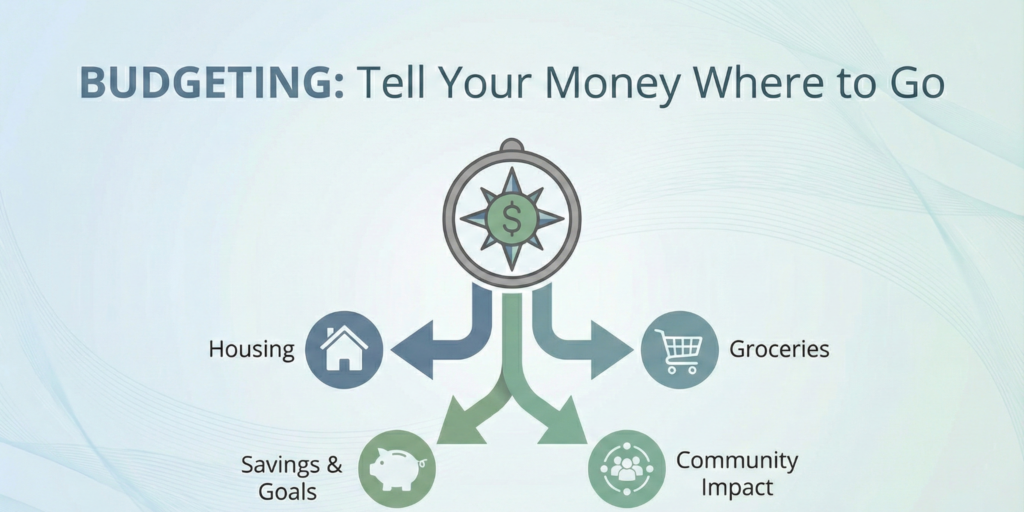
Most of us treat our bank accounts like a mystery box. We check our balance just before making a transfer and hope the money lasts until the next salary enters. This way of living creates a constant, low-level stress that follows us everywhere.
The problem is not usually that we do not know how to subtract expenses from income. The problem is that we view budgeting as a financial “dieting” where we cut out everything good.
But a true budget is not about being stingy to yourself or others; it is simply a way to spend your money without guilt.
Give Every Naira a Job
The best way to take control is the “zero-based” method. The idea is that, before the month starts, you take your total income and give every single Naira a specific job until you have zero Naira left unassigned. This does not mean your account balance hits zero; it means you have decided exactly where every kobo is going.
Let’s look at a practical example. Imagine your take-home pay is ₦300,000 a month.
First, you cover the Essentials. These are the bills you must pay to survive: rent (saving a bit monthly towards the yearly payment), food, electricity/fuel, and transport. Let’s say this takes up ₦160,000. You now have ₦140,000 remaining.
Next, look at Debt and Savings. If you have loans or are saving for an emergency fund (for when life happens), that money should move now. Let’s assume this takes another ₦60,000.
You are left with ₦80,000. This is where most people lose control. They leave this money in the account and tap their card or make transfers until it is gone.
Instead, you must assign this to Flexible Spending. This includes data, eating out, airtime, and family obligations (“black tax”).
The magic happens when you realize you have set aside ₦15,000 specifically for “Enjoyment.” When you buy lunch or go out with friends, you don’t feel worried. You know you can afford it. You planned for it.
Stop Guessing, Start Checking
A budget on paper is useless if it does not match real life. You have to track where the money actually goes.
Research shows that people are very bad at “mental accounting”; we consistently overestimate how much we spend on small things like data top-ups, snacks, or transport fares.
To fix this, you need a routine. You don’t need to write down every expense as it happens, but you do need to review it regularly.
Try the “Weekly Check-In.” Pick a time, maybe Sunday evening, to review your spending from the last seven days. This helps you catch mistakes or see if you are spending too fast.
If you notice by the middle of the month that food prices have gone up and you have spent more on groceries than you planned, don’t give up. Simply look at your other categories. Can you move ₦5,000 from the “Clothes” or “Data” money to cover the food?
This is what experts call “slack” or wiggle room. Rigid plans break easily; flexible plans survive. Moving money from one category to another is not failing; it is managing.
Making It Stick
The goal here is not to create a perfect spreadsheet. The goal is to build a habit that reduces your stress.
Start by looking at your bank statement for the last few months to see what you actually spend, not what you wish you spent. If you spend a lot on data, put it in the budget. If you hate cooking and buy food often, budget for it.
When your plan matches your real life, budgeting stops feeling like a chore. It starts feeling like a clearer way to see your life. You stop wondering where your money went and start telling it where to go.